
Home Water Safety: What to Ask Before You Buy
If you’re like 70% of Iowans, you probably use some sort of water filter. These may range from simple countertop jugs to more advanced methods. If you’ve ever shopped around, you may have compared options and noticed some suppliers advertise some sort of “certification”.
A certification label can be reassuring when you are shopping for a water filter. It looks official and sounds scientific. It can make a system feel safer before you even know what it does.
However, water filtration expert Steve Murtha warns: “We have seen that a water filter can legitimately be certified for its components and advertised in a way that makes it sound like it proves their reduction of nitrates”.
Meaningful third-party certifications can be useful. The problem is that a certification is only helpful when you know:
1. Exactly what was tested
2. What contaminant it applies to
3. Whether you actually need that information
Local water concerns like nitrates, hardness, chlorine taste, PFAS, and seasonal water quality changes are not solved by one generic label. The right solution depends on what is actually in your water, how your household uses water, and whether the system has evidence behind the specific claim being made.
A Certified Car Does Not Mean the Airbags Are Certified
A certification usually means a product, system, material, or component was tested against a specific standard. That sounds simple enough.
For example, NSF (National Sanitation Foundation) lists certified water treatment systems by the contaminants they are designed to reduce, including reverse osmosis systems for nitrate and nitrite reduction. That is useful information because it connects the certification to a specific performance claim.
A vague phrase like “NSF certified“, however, is not enough by itself. You still need to know what standard applies, what model was tested, what contaminant was tested, and what conditions were used during testing.
Think of it this way: if a car part is certified, that does not automatically mean the whole car has passed every safety test. A certified tire does not prove the brakes, airbags, engine, or seat belts are right for your family. In the same way, a certified tank, housing, fitting, or material does not automatically prove the whole water treatment system removes nitrates, PFAS, chlorine, or any other contaminant from your water.
That is the difference between a meaningful claim and a misleading one.
The Big Question: What Was Certified?
Steve urges Iowans: “When a company says a water system is certified, pause and ask one simple question: what part of the system is certified, and for what purpose?”
A certification might apply to:
• Tank structure
• Material used in the system
• Pressure safety
• Reduction of a specific contaminant (under specific test conditions)
So this is exactly where homeowners can get misled online. A product page may place a certification badge near a claim about nitrate removal or whole-home filtration, but the certification itself may not support that exact claim. The badge may be real while the implication is still confusing.
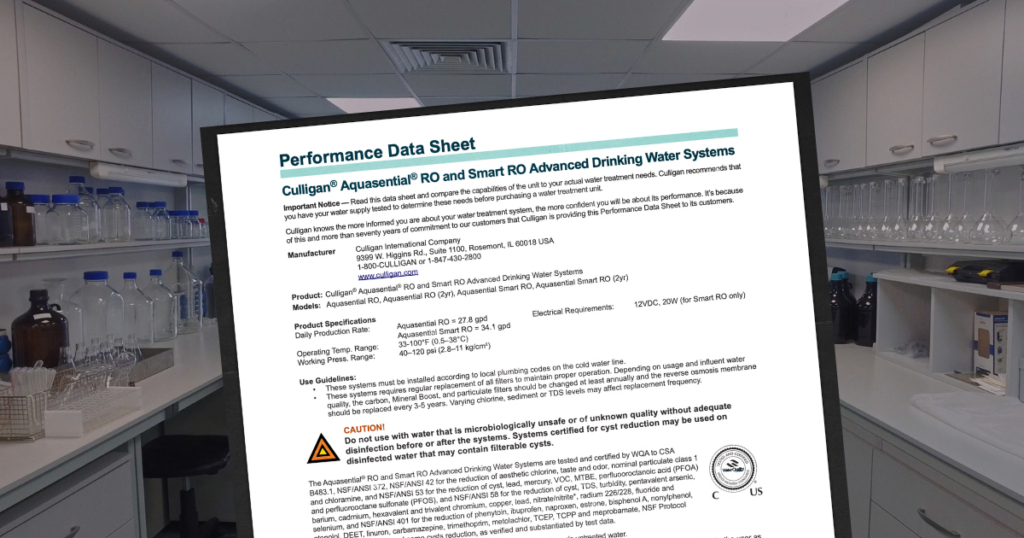
Before you trust the claim, ask for the performance data sheet (it can look like this) or product certification listing. A reputable company should be able to show you what the system is certified to do, which model it applies to, and what water conditions the test assumes.
The Best Starting Point: An In-Home Water Test
No certification can replace testing the water in your home.
A water treatment system is not chosen in a vacuum. The same filter may perform differently depending on:
• The starting water quality
• Flow rate
• Household usage
• The mix of contaminants present
Steve from Culligan of Des Moines explained this well: “Before recommending a system, a legitimate process should account for how many people live in the home, how much water the household uses, and the actual test results for that water.”
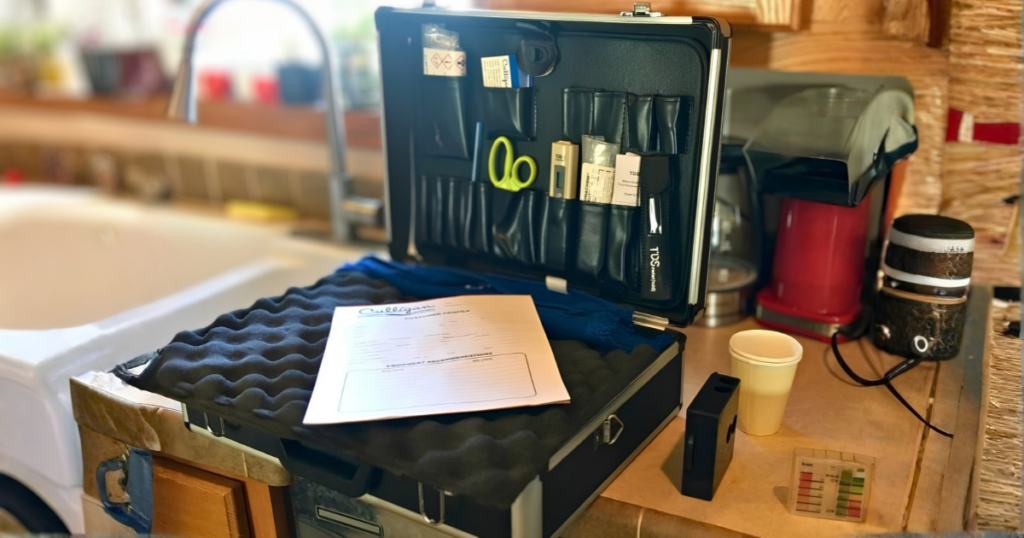
At minimum, a good in-home water conversation should include tests for the concerns that matter to the recommendation. For Des Moines area homes, that’s often nitrates, the stuff we hear so much about in the news, but also hardness, which causes damage to appliances in the long term as well as PFAS.
Pop Quiz: If a salesperson tells you that you need a nitrate treatment system, they should:
🚫Use scare tactics
🚫Show a generic map
🚫Tell you that everyone in the neighborhood has the same issue
✅Be able to show you the nitrate reading taken in your own home
A major red flag is a salesperson diagnosing a problem they have not tested for.
What Reduces Nitrates
Nitrates are one reason Des Moines families are asking more questions about water treatment. Des Moines’ Water Works works hard to keep levels in supplied water at the nationally set legal limit of 10 ppm. But this can be a false security. Numbers in city water can still fluctuate. And the EWG doesn’t even deem 10 ppm as a safe, but rather 0.14 ppm. So a homeowner still needs to know what the water at their tap measures, whether the source is city water or indeed a private well.
Reverse osmosis is commonly used for drinking water concerns because it treats the water you drink and cook with at the point of use. Whole-home systems may make sense for other concerns, such as hardness, chlorine taste and odor, or broader household water quality goals. Also read our guide on different systems: Soft Water vs Filtered Water or Reverse Osmosis
That is why a credible company should be comfortable slowing down, testing first, and explaining the options in plain language.
How To Vet A Water Filter Claim Before You Buy
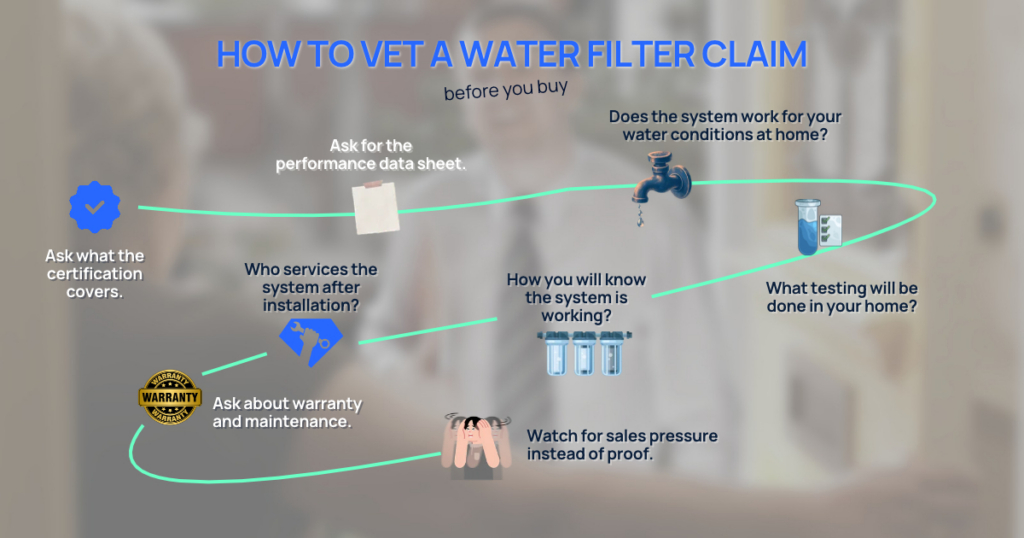
If you are comparing water filtration companies online, use this checklist before you trust a certification badge or a polished sales page.
1. Ask what the certification covers.
Does it apply to the full system, one component, the tank, the material, the pressure rating, or a specific contaminant reduction claim?
2. Ask for the performance data sheet.
A real performance claim should have documentation behind it. Look for the exact model, contaminant, reduction claim, testing conditions, and maintenance requirements. This is what it could look like.
3. Ask whether the system is right for your starting water.
A system that works for city water may not be the right fit for well water. The latter especially can be multiple issues at once (for example: bacteria, PFAS, nitrates, smell… etc)
4. Ask what testing will be done in your home.
If the recommendation involves nitrates, ask for the nitrate measurement. If it involves hardness, ask for the hardness reading. If it involves taste, odor, TDS, chlorine, or PFAS concerns, ask how those concerns are being evaluated.
5. Ask how you will know the system is working.
A trustworthy recommendation should include a plan for verification. That may include a follow-up water test, a TDS reduction check for a drinking water system, or another measurable way to confirm performance.
6. Ask who services the system after installation.
Buying a filter is one thing. Living with it for years is another. If a company tells you to maintain it yourself, ask what happens if you do not want to, cannot, or are unsure whether it is working correctly.
7. Ask about warranty and maintenance.
How often do filters need to be changed? What does the warranty actually cover? Is service available locally? Are replacement parts easy to get?
8. Watch for pressure instead of proof.
If the sales pitch gets bigger while the evidence stays vague, slow down. A good water specialist should be able to explain the numbers, not rush you past them.
What Questions to Ask
A certification can be a good sign. It can show that a product or system was tested against a recognized standard. But it should never be treated like a blank check.
For homeowners, the useful question is not simply, “Is it certified?” The better question is, “Certified to do what, on which model, under what conditions, and does that match my water?”
That question protects you from two common mistakes: buying a system that is not designed for your actual concern, or trusting a broad claim when only a narrow part of the equipment was certified.
The best water treatment process should feel transparent from the beginning. You should understand what was found in your water, why a solution is being recommended, what it is expected to reduce, how it will be maintained, and how performance can be checked later.
Local Service
Online water filter shopping can make every system look simple. Click, buy, install, done.
But water treatment is not always that neat. Flow rate, water pressure, plumbing layout, maintenance, household water use, and local water conditions can all affect the right setup. And after installation, filters and membranes still need to be serviced on schedule.
That is why post-sale service should be part of your decision. If something changes, who do you call? If the water tastes different, who checks it? If a filter needs replacing, who handles it? If you move or your water source changes, can the system be adjusted? Also read: How to check if your water softener is still working.
A good company should not disappear after the sale. They should be able to test, install, maintain, and explain the system in a way that gives you confidence long after the first appointment.
The Bottom Line For Des Moines Homeowners
A certified water filter can be trustworthy, but only when the certification matches the claim being made.
What to remember when comparing:
• Ask what was certified.
• Ask what contaminant it applies to.
• Ask for the performance data sheet.
• Ask for your actual water test numbers.
• Ask who will service the system after installation.
Culligan of Des Moines helps homeowners cut through confusing water treatment claims with free local water testing, plain-language recommendations, and service after the sale. If you are not sure whether a system is right for your home, start with the numbers.
HELPFUL RESOURCES:
NSF Contaminant Reduction Claims Guide -> https://www.nsf.org/consumer-resources/articles/contaminant-reduction-claims-guide
EPA National Primary Drinking Water Regulations -> https://www.epa.gov/ground-water-and-drinking-water/national-primary-drinking-water-regulation
Frequently Asked Questions
A local company can test your water, account for your home and plumbing, install the right system, and provide service after the sale. This is to ensure the system does what it supposed to months or years after installation.
Be cautious if a company says you need a specific treatment system without testing for that specific issue. If someone recommends nitrate treatment, they should be able to show you the nitrate measurement in your water.
Reverse osmosis systems are commonly used for nitrate and nitrite reduction in drinking water applications. The exact performance depends on the system model, starting water quality, and maintenance, so ask for the performance data sheet and test results.
Ask for your actual nitrate test result, the performance data sheet for the specific system, the expected reduction, the maintenance schedule, the warranty, and how the company verifies performance after installation.
Yes. A certification may apply to a component, material, tank, pressure rating, or a specific contaminant reduction claim. That is why homeowners should ask what exactly was certified.
Not automatically. NSF certification can be valuable, but you need to know what the certification covers. A product may be certified for one contaminant, material, or component, while your home may need help with a different water issue.


