Voting for Clean Water? What Iowa’s Nitrate Debate Means for Your Tap
As election season approaches across Iowa, public discussion naturally turns to the key issues shaping local communities. Alongside economic and civic debates, water quality consistently emerges as a core priority for central Iowa voters.
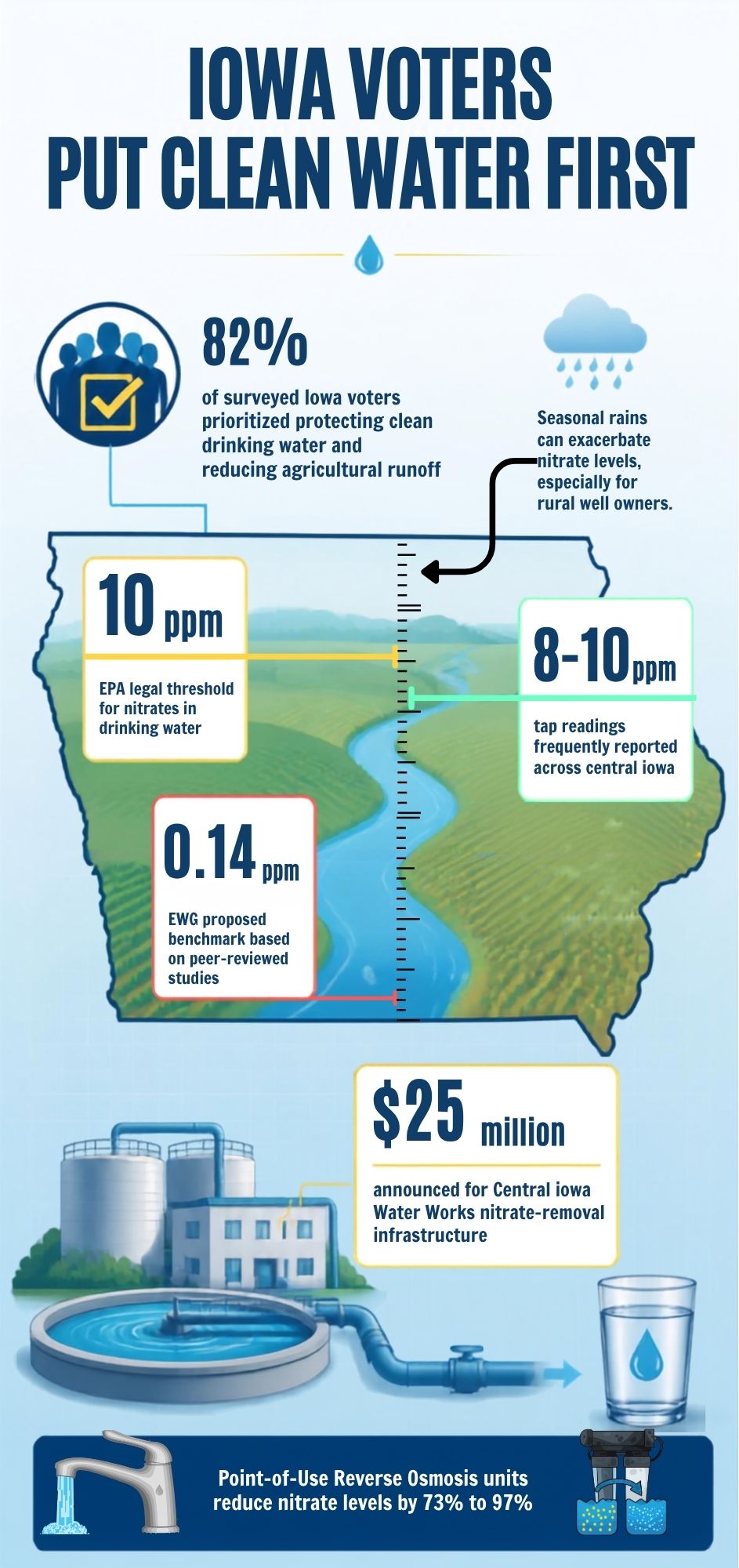
A survey conducted by Global Strategy Group and Food & Water Action found that 82% of surveyed Iowa voters prioritized protecting clean drinking water and reducing agricultural runoff. Outlets such as The New Lede have detailed how public health concerns regarding pollution are central themes for voters, while Inside Climate News has highlighted the ongoing legislative debates surrounding stream monitoring and winter agricultural runoff.
While water quality remains a prominent topic in political discourse, understanding what these conversations mean for your everyday drinking water requires cutting through the noise and looking at the facts.
Shared Priorities Across Political Lines
Although policy approaches differ, leaders across the political spectrum acknowledge that clean drinking water is vital for Iowa’s future.
Discussing legislative environmental priorities during the session, State Sen. Art Staed (D-Cedar Rapids) noted in an Inside Climate News report:
“Iowa’s waterways have the highest cancer-link nitrate concentrations in the nation, and our water crisis has reached a breaking point. Protecting clean water must be a shared priority.”
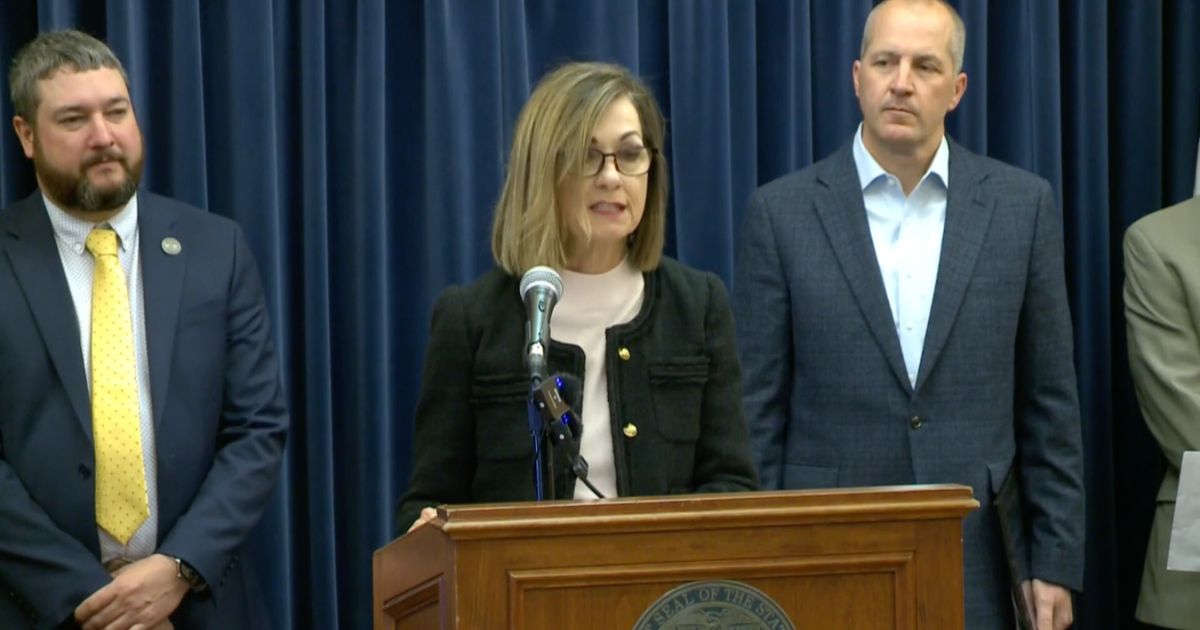
There is also bipartisan recognition that this issue extends far beyond any single industry. In a press conference announcing $25 million for Central Iowa Water Works nitrate removal infrastructure, reported by Brownfield Ag News, Gov. Kim Reynolds (R-Iowa) emphasized unity in addressing water health:
“Together, we’re all part of the solution because water quality isn’t a farm issue, it isn’t a city issue, and it isn’t a political issue, but it absolutely is non-negotiable.”
This sentiment is echoed by leaders like State Auditor Rob Sand (D), who recently told Radio Iowa that Iowans across the political spectrum want to see substantial investments in conservation programs and monitoring.
A Shared Ecosystem: Moving Past the Blame Game
Governor Reynolds’ observation that water quality “isn’t a farm issue” reflects a practical reality that West Des Moines local and third-generation water-treament business owner Steve Murtha strongly agrees with: “Nitrate runoff is a multifaceted challenge. It involves agricultural practices, seasonal rainfall, municipal management, and even urban lawn care.”
He continues: “Assigning blame to one group or relying solely on election outcomes does not instantly change the chemistry coming out of a household faucet.” Resolving watershed issues takes years of cooperation. Fortunately, understanding local nitrate levels and protecting drinking water at home is something homeowners can manage themselves.
Facts vs. Headlines: Understanding Nitrate Numbers
To make informed decisions about your household water, it helps to distinguish between regulatory standards and local conditions.
• EPA Legal Threshold: The U.S. Environmental Protection Agency (EPA) sets the Maximum Contaminant Level for nitrates at 10 parts per million (ppm). Municipal systems like Des Moines Water Works are legally required to keep treated drinking water below this limit.
• EWG Health guideline: The Environmental Working Group (EWG), an independent research organization, recommends a stricter health benchmark of 0.14 mg/L (0.14 ppm) based on studies examining long-term health risks.
• Seasonal Fluctuations: Nitrate levels in local water sources vary seasonally. Heavy spring rains and summer runoff wash field fertilizers into rivers, driving short-term spikes. This is especially true for rural homeowners, making protecting well water after storms a critical step.
• Expert Realities: As highlighted in a report by The Gazette, environmental health experts emphasize that “risk-free drinking water doesn’t exist in Iowa.” Municipal facilities work hard to keep treated water within federal standards, but source water conditions frequently shift.
Des Moines Water Works operates the world’s largest municipal nitrate removal facility. When river levels spike, this facility treats a portion of the water to near-zero levels and blends it back into the general supply to stay under the 10 ppm federal cap. While this blending keeps municipal water compliant, tap readings across central Iowa frequently hover between 8 and 10 ppm.
As Policy Changes Take Time, Homeowners Protect Themselves
Legislative action and municipal upgrades are essential long-term strategies, but they operate on multi-year timelines. Homeowners who want additional peace of mind do not have to wait for election results or regulatory updates to get clean water.
Point-of-Use Reverse Osmosis
Nitrates are only a concern when ingested. They are not absorbed through the skin during showers, baths, or dishwashing. Because of this, whole-home nitrate systems are rarely necessary for municipal water customers.
Installing an under-sink reverse osmosis drinking water system provides an efficient and target-specific solution. High-quality reverse osmosis systems reduce nitrates in drinking and cooking water by 73% to 97%, filtering out unwanted compounds right at the tap. You can read more about how this works in our guide featuring answers to common nitrate questions.
Test First: Start With Objective Local Data
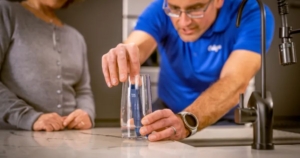
Before investing in any home filtration equipment, the first step should always be an accurate assessment. At Culligan of Des Moines, our core philosophy is simple: test first, diagnose before recommending, and verify performance over time.
Knowing your exact numbers allows you to make calm, practical choices tailored to your home’s needs rather than political campaign rhetoric.
While political discussions around Iowa’s waterways will continue through November and beyond, your family’s drinking water quality is something you can measure and manage right now.
Schedule your free in-home water test today to see what is in your tap water and explore your options.
Frequently Asked Questions
Quality point-of-use reverse osmosis systems typically achieve a 73% to 97% reduction in nitrates at the tap. Following installation, performance should be verified using a before-and-after test alongside leak and production checks.
Red flags include sales representatives who recommend equipment without testing water first or who claim nitrate levels are above 100 ppm, which would require a public utility shutdown and alert. Homeowners should also beware of sales pitches citing structural tank ratings (such as NSF 52) as proof of nitrate removal performance.
A thorough in-home test should measure four specific parameters: water hardness, Total Dissolved Solids (TDS), chlorine levels, and nitrates. Testing should rely on calibrated equipment rather than neighborhood assumptions or property assessor records.
No. Nitrates are only a health risk when ingested and are not absorbed through the skin during showering, bathing, or doing laundry. A point-of-use reverse osmosis system under the kitchen sink effectively targets drinking and cooking water at a fraction of the cost.
No. The facility treats a portion of incoming water to near-zero nitrate levels and blends it back with untreated water to keep the overall supply below the EPA legal threshold of 10 ppm. Consequently, tap water readings across central Iowa frequently hover between 8 and 10 ppm.